
"I Illustrate Hairy, Brown Women": Disrupting Outdated Notions of Femininity with Paradise Khanmalek

Paradise Khanmalek with the poster she designed for LAZF.
A historically underground and subversive scene, zine fests bring together artists. At Giant Robot Media, our roots come from zines and DIY culture so it was wonderful to attend the sixth annual LA Zine Fest in downtown LA at the California Market Center. Cheery conversation floated through the room full of artists, most of whom were local with a spattering of international zinesters. There were over 200 zinesters tabling and we got to meet a few.
Paradise Khanmalek, 24, is the artist who designed the official posters for LA Zine Fest. Her vibrant digital art depicts the beauty and strength of hairy, brown women.
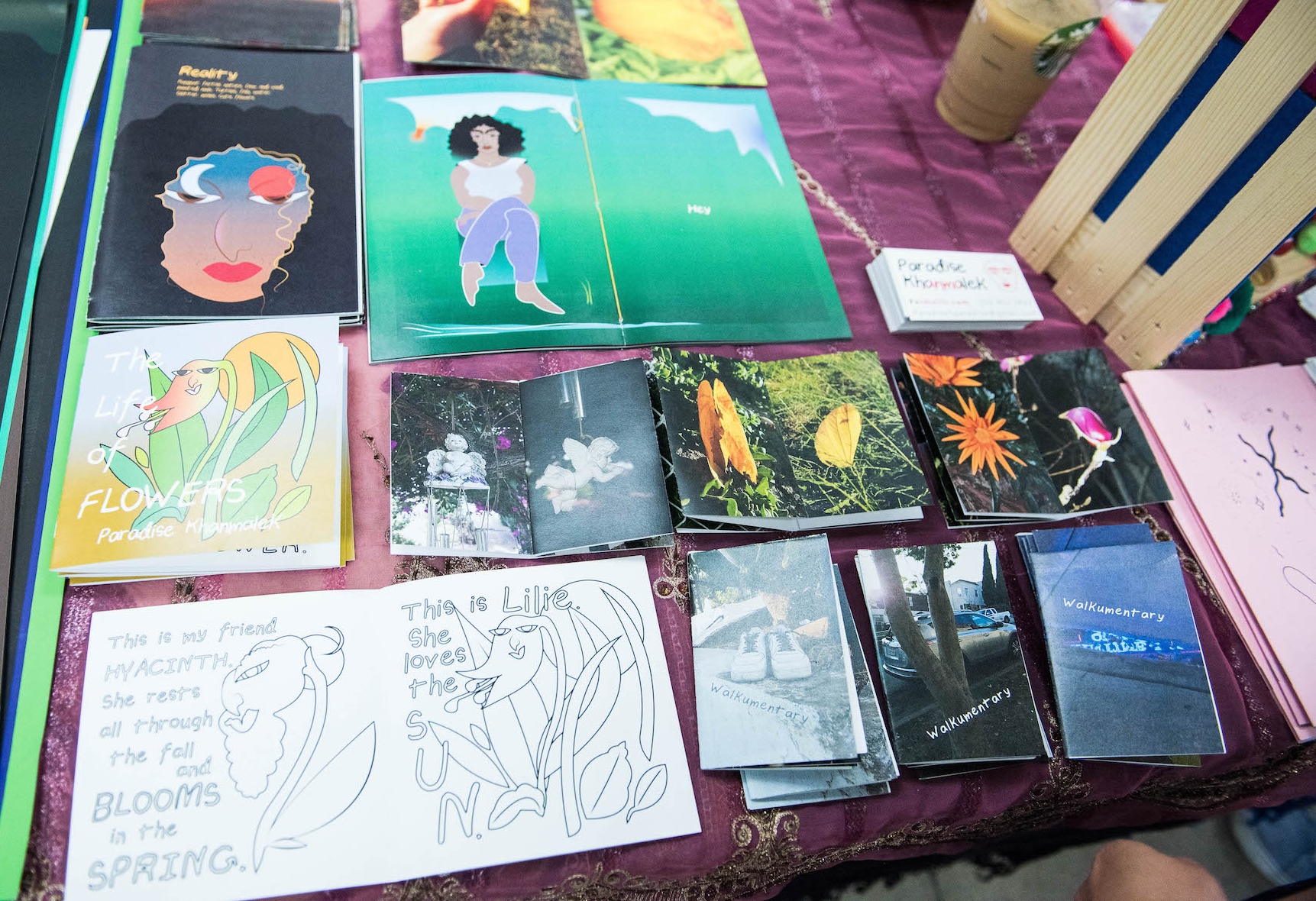
Zines at Paradise's table.
By Riki Robinson
Photos by George Ko
GR: Can you just start off by talking about who you are and what you do?
Paradise Khanmalek: My name is Paradise and I'm trying to illustrate a world of fat, brown girls to make me feel better mentally and physically. I take photographs of nature and flowers. I also write poetry about magic, science fiction, life as a fat brown girl, and love. I'm interested in science fiction themes and racial, sexual themes. I’m just living a happy fulfilling life and making art.
GR: How did you get interested in the zine and DIY culture?
PK: I wanted to make something. I wanted to make my own books. When I was younger I felt really uncomfortable in established, institutional art spaces. I didn't necessarily feel welcome in high end art gallery spaces because I didn't see any work about brown girls or by brown girls or about being hairy or being queer. I didn't really get a lot of motivation or support in that kind of space. But ever since I started going to zine fairs and more alternative spaces for art making, I have met so many queer people of color, so many friends, so many people making work about being fat and queer women. It's incredible. It's like night and day from mainstream, institutional art stuff and DIY, self-publishing zines.
I even did a whole research project in college about mainstream publishing. The percentage of books by people of color or about people of color is so low. I forgot the exact statistic, but it’s something like 90% of books reviewed by the New York Times are by and about white people. So I was like, I want to make books. And I want to make posters. And I want to make art. And I'm just going to do it myself and I'm going to hangout with my friends, like Carmen Johns (tabling next to Paradise at LA Zine Fest). I'm going to go to these kind of events and have a good time and just try to build some sort of career and some sort of mental health practice.

Paradise makes portraits of fat, hairy, brown women. Source: Paradise Khanmalek.

Another portrait by Paradise. Source: Paradise Khanmalek.
GR: When did you start making zines?
PK: I started making zines when I was 19. I'm 24 now. I made this series called "Golden Bitch." That was my first zine series and it was really fun. It was collages and drawings of my mom and grandma and glitter. I made it every few months. Then I made a series of zines called "Islam Book" because I was just having fun. I'm still making books but now I'm more into poetry and digital illustration. I had a back injury so I can't really draw and paint anymore so I just do all digital illustration. And I love it. I love it conceptually, physically, materially. I find it fascinating because I'm into science fiction. So it's even more conceptually interesting for me to be working with a computer. I'm still doing my thing.
GR: How were you approached to do the artwork for LA Zine Fest?
PK: I've been coming to LA Zine Fest since 2014 and I tabled last year for the first time. I got to know Rhea Tepp at the zine fest and other events. She asked me if I would do it and I was like, "Hell yes! I love this event. I come every year and it's super fun. All of my friends table at it. Of course I want to do the artwork for it.”
I was sitting down to draw it and I thought I want to illustrate a young woman of color working on her art at night. I feel like so many zinesters here are young women of color working during the day and then coming home and doing their passion and making beautiful, powerful work at night. I'm a zinester. I'm doing my own thing. All these people are doing their own thing and I want to represent them.
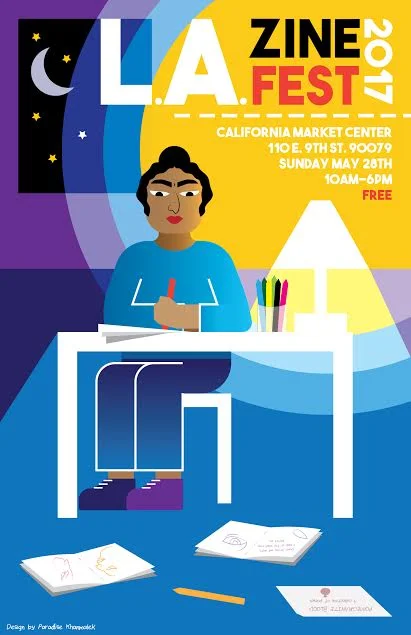
The poster created for for LA Zine Fest. Source: Paradise Khanmalek.
GR: Do you have a day job?
PK: I do, yes. I'm a graphic designer at a grocery store.
GR: What's it like working for a grocery store and doing graphic design for them versus doing it for yourself?
PK: Making my art is literally healing for me, mentally. Drawing these hairy, brown women is part of my mental health practice. It makes me feel good to draw a family or a community that is beautiful and makes me feel beautiful, valuable, and magical. I love graphic design, too, because I love illustrating on the computer. It's fun. But obviously going to work and making advertisements for shelf sizes is not a healing practice. It's a job.
GR: Last night, I went to a pre-LAZF reading and heard you read your poem “I Am Holy.” What works are you especially proud of?
PK: The poem that I read, "I Am Holy," that's definitely my favorite poem. It's the most recent thing I've made. I'm most proud of it. I feel like making that poem was such an intense journey. I originally wrote it for the QAHWA magazine. It was a really great online magazine for Middle Eastern, North African, and Southwest Asian artists. My editor, Lena, really worked with me on that p